The Matching Furniture Set Is Not a Room Plan
A matching furniture set can make a room feel flat. Choose one shared visual cue to connect different pieces without making them identical.
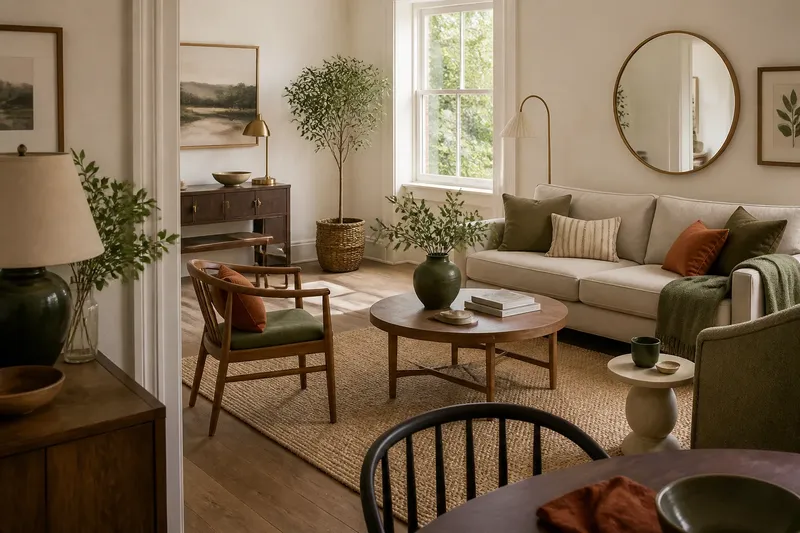
Does a matching furniture set make a room feel cohesive, or simply make every piece look as if it arrived together? A matching furniture set can provide an easy starting point, but a shared visual cue—such as warm wood, rounded corners, or a muted green—often gives a room more character while keeping its pieces in conversation.
1. Choose a cue before choosing another piece
A set offers ready-made agreement: the bed, dresser, and nightstands repeat the same finish and shape. That agreement can be useful, especially when furnishing a room from scratch. But cohesion does not require identical pieces. It requires a reason for the pieces to sit together.
Pick one visible quality to repeat. It might be a material, a color, a shape, or a finish. Keep the cue specific enough to guide decisions: “honey-toned wood” is more useful than “natural,” while “soft curves” gives you a clearer direction than “comfortable.”
Say you have a dark walnut dining table and chairs that do not match. If you choose a shared cue of warm, earthy color, you might keep the table, add rust-colored seat cushions, and bring in a clay-toned bowl. The expected result is a dining area whose pieces relate through color, even though their wood finishes and forms differ.
2. Let color connect different materials
Color can bridge materials that would otherwise seem unrelated. A moss-green cushion on a wood chair, a green-glazed lamp on a painted side table, and a small botanical print can repeat a quiet note without turning the room into a matched collection.
Think about the color’s temperature and intensity as well as its name. A gray-green with a dusty quality may sit comfortably beside warm oak, while a sharp, cool green could pull attention away from it. A paint chip or fabric swatch held beside the furniture can help you judge that relationship in the room’s actual light.
Use the cue at different scales. A larger piece can carry a subdued version, while smaller objects provide clearer accents. This keeps the connection noticeable without requiring every item to use the same exact shade.
3. Repeat a shape without repeating a set
Shape offers another way to create continuity, particularly in a room with varied colors and materials. Rounded edges might appear in an oval mirror, a curved-back chair, and a circular side table. Their shared outline gives the eye a pattern to follow while their differences keep the room from feeling copied.
Look for a shape that already exists in a piece you want to keep. Then repeat it in a different role rather than buying several versions of the same object. A rounded lamp base, for example, can echo a chair’s curved arms without matching its upholstery or finish.
Keep the repetition selective. If every object is round, the cue stops helping the pieces stand apart. A few clear echoes are enough; straight lines and contrasting forms give those echoes room to register.
4. Use material and finish as a quiet link
Different furniture can share a material quality without sharing a manufacturer or design. A brushed brass detail on a cabinet pull may relate to the warm metal stem of a floor lamp. A woven seat can connect to a basket or a natural-fiber shade.
Finish matters. Polished brass and aged brass both read as warm metal, but their shine and visual weight differ. If the distinction feels too strong, repeat the finish in a small object or hardware detail rather than adding another large piece.
Wood is especially forgiving when treated as a family of related tones rather than a demand for exact matches. Pay attention to whether the wood reads warm, cool, pale, or dark. A room can hold several wood finishes when another element—such as a rug color or a repeated silhouette—helps them belong together.
5. Keep one piece that resists the cue
A room needs some difference to feel collected rather than assembled from a formula. An inherited chair, a painted cabinet, or a small table with an unexpected finish can supply that difference. The shared cue does not need to explain every object.
Give the outlier a little breathing room. If it sits among several similar pieces, its contrast can look accidental; placed where its color or shape has space around it, the difference reads as intentional. You can also connect it lightly through a nearby book, textile, or artwork without disguising what makes it distinct.
This is a useful point to pause before replacing furniture. If a piece works for the room and matters to you, test whether a color, material, or shape nearby can bring it into the larger conversation. Cohesion is not the same as uniformity.
6. Check the cue from the doorway
Furniture is experienced as a whole arrangement, not as a row of product finishes. Stand at the room’s entrance and notice what catches your eye first. Then look for whether the repeated cue helps your gaze move from one area to another.
If the cue disappears, it may be too subtle or isolated. Repeat it in a second, different form: a color in a cushion and a ceramic object, for instance, or a curved edge in a chair and a mirror. If the cue dominates, reduce its scale or let one occurrence go.
For a practical check, gather a few swatches, a paint chip, or phone photos of the pieces you already own. Compare them together under the room’s usual lighting, then decide whether the connection feels clear without making every item look alike. Follow product labels and manufacturer instructions when choosing finishes or caring for furnishings.
What should tie different furniture together?
Can different wood tones work in one room?
Yes. Consider whether the tones share a warm or cool cast, then use a color, texture, or repeated shape to connect them. Exact wood matches are not necessary for a room to feel considered.
How many colors should a room repeat?
There is no fixed number that suits every room. Choose one color cue you can recognize across more than one object, and let the remaining colors support it rather than competing for equal attention.
What if my furniture already comes as a set?
You can keep the pieces that serve the room and break up the repetition with different lighting, textiles, or a distinctive side table. There is no need to replace a usable set just to create visual variety.
How do I know whether a cue feels too obvious?
Look away for a moment, then take in the room from the doorway. If the repeated detail is the only thing you notice, soften or remove one instance; if you cannot find any connection, repeat the cue in another form.
A matching furniture set is one way to create order, not the only way. Start with a piece you want to keep, choose one shared visual cue, and let the rest of the room answer it in varied forms. That approach makes the matching furniture set less of a requirement and more of a choice.