Curtains or Blinds for a Window That Feels Unfinished
Curtains or blinds can shape a room’s window in different ways. Compare framing, visual weight, and daily use to choose a treatment that fits your space.
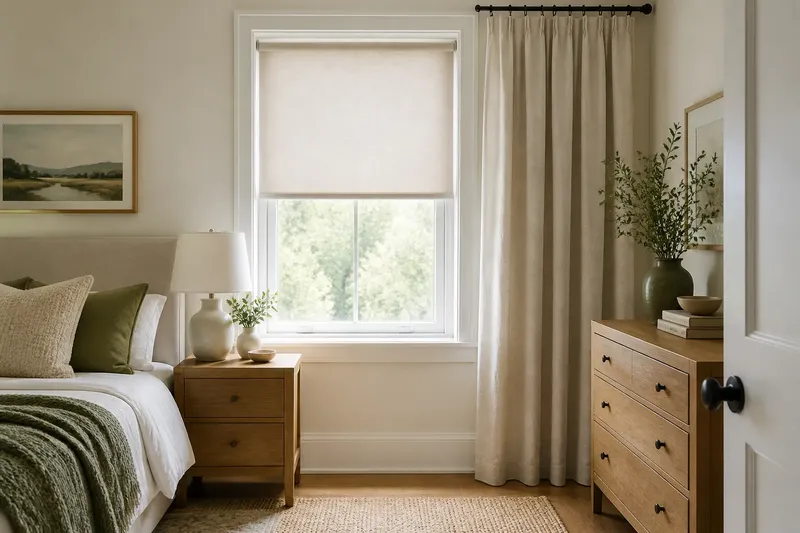
Should curtains or blinds make a bare window feel finished without crowding the wall? Curtains or blinds can shift how the opening reads: fabric panels extend the frame into the room, while a close-fitting blind keeps attention nearer the glass. Start with the view from the doorway, then consider what the window shares space with.
Curtains or blinds change the window’s visual frame
Curtains make a window part of a larger stretch of wall. Their panels can sit beyond the glass and soften a square opening without changing its shape. Plain cotton or linen can keep the effect restrained; a patterned or heavier fabric gives the window more presence. The result depends on fabric, folds, and placement, not just the label “curtains.”
Blinds keep the treatment closer to the window frame. A roller blind creates a relatively continuous surface, while Venetian slats add horizontal lines. Roman blinds bring fabric folds but usually stay within the opening. Each can be quiet or conspicuous depending on color, texture, and contrast.
Look at the architecture before choosing. Deep trim may make a fitted blind feel at home. A bare wall may benefit from curtain panels that give the opening a defined border. For a bay, arch, or off-center window, consider how the treatment relates to the shape instead of assuming a standard design will correct it.
Check how the covering relates to furniture
A curtain panel may overlap a bedside table, radiator, desk, or cabinet when drawn. A blind avoids that fabric overlap, but its raised or rolled position and control still need to make sense. Consider the open and closed views, not only how the covering looks when it is untouched.
Use the room’s existing forms as clues. Rounded upholstery and a woven rug may already bring softness, so crisp blinds could add contrast. In a room with painted wood, metal, and clean edges, curtains can introduce a fabric surface. These are possibilities, not rules; the material and color matter as much as the type of covering.
Here is a fully worked, invented situation. Say a bedroom has a narrow window, a pale wall, and a bedside table close to one side. The starting choice is between a plain roller blind that matches the wall and one curtain panel in a light, low-contrast fabric. First, place a blind sample beside the trim and view it from the doorway; it blends with the wall, so the window remains the more distinct element. Next, hold the curtain sample at the proposed side of the opening; its folds add a visible fabric edge, but overlap the table in the drawn position. The resulting decision is the roller blind if keeping the table unobstructed matters more; choose the curtain if that fabric frame matters more and the overlap is acceptable. These are imagined observations, not a claim about a real room.
Match the treatment to the room’s daily use
Think through the moments when you will move the covering. In a living room, you may leave it open for much of the day and draw it when you want more privacy. Open curtains remain visible at the sides; a raised blind leaves the wall and window edges clearer. In a bedroom, the closed view may matter more because it sits alongside bedding and wall color.
Appearance, privacy, light control, and glare are separate considerations. Slatted blinds can be adjusted by changing their angle. A roller blind changes how much of the glass it covers as it moves. Curtains draw across the opening, and their fabric affects the light that passes through. Compare the specific material and construction rather than relying on the product category alone.
Layering is another option. A blind close to the glass can provide a contained layer, while curtains add a fabric frame. The combination also adds hardware and visual detail. Use both only if each has a distinct purpose and the room looks composed with either one open.
Use a visual checklist to make the choice
For each item, note what you see in the room, then follow the decision that fits. If the first option does not fit, use the alternative action.
- Wall space: Check whether there is clear wall on both sides of the opening. If there is, then consider curtains that extend beyond the glass; if not, compare a blind or a narrower curtain arrangement.
- Nearby furniture: Check whether a drawn panel would overlap a table, desk, or cabinet. If it would and that feels inconvenient, then favor a blind; if the overlap is acceptable, keep curtains in consideration.
- Existing texture: Check whether the room already has strong fabric, rugs, or upholstery. If it does, then consider a simpler blind; if it feels visually hard, compare a curtain fabric sample.
- Window trim: Check whether the trim is a feature you want to keep visible. If it is, then look at a treatment that sits within the opening; if you want a wider frame, consider curtains beside it.
- Open position: Check where the covering gathers when open. If a raised blind’s top roll would distract you, then compare curtains at the sides; if side panels would crowd the wall, look at a blind.
- Closed appearance: Check each sample against the wall and furnishings with the covering drawn. If a bold contrast feels too prominent, then choose a closer tone; if the window needs a focal point, compare a more distinct color or texture.
Which curtains or blinds questions help settle the choice?
Do curtains make a window look larger?
Panels placed beyond the glass can make the framed area read more broadly, but the effect depends on available wall space and fabric volume. If the wall is tight, extending the panels may crowd nearby furniture instead.
Are blinds always less noticeable than curtains?
No. A colored Roman blind or patterned slats can draw attention, while plain curtains close to the wall color may recede. Compare the actual finish and contrast in the room.
Can curtains and blinds be used together?
Yes, if each layer has a distinct purpose, such as a blind for a close-fitting covering and curtains for a fabric frame. Check that the layers look intentional and do not compete with the trim or nearby objects.
Which treatment suits an unusually shaped window?
It depends on the shape and the details you want to preserve. Compare options designed for an arched, angled, or bay window, and consider whether the treatment should follow the opening or draw attention to the surrounding wall.
Choose by comparing the whole wall
Before ordering, compare the window uncovered, covered, and partly open. Hold a fabric sample or blind finish beside the trim, then look from across the room as well as close up. A texture that seems quiet in your hand may look more prominent against a broad wall.
For curtains or blinds, the useful distinction is how much of the wall the treatment occupies and what remains visible when it is open. If a sample blends in but the room still feels bare, consider whether the window needs a fabric frame; if panels crowd nearby objects, return to a closer-fitting option. That last comparison often clarifies which tradeoff you actually prefer.