The Hallway Before the Hallway: A Short History of the Home Entrance
Home entrance history connects the Roman atrium, the Georgian hall, and today’s entryway, showing how each arrangement can shape arrival and privacy.
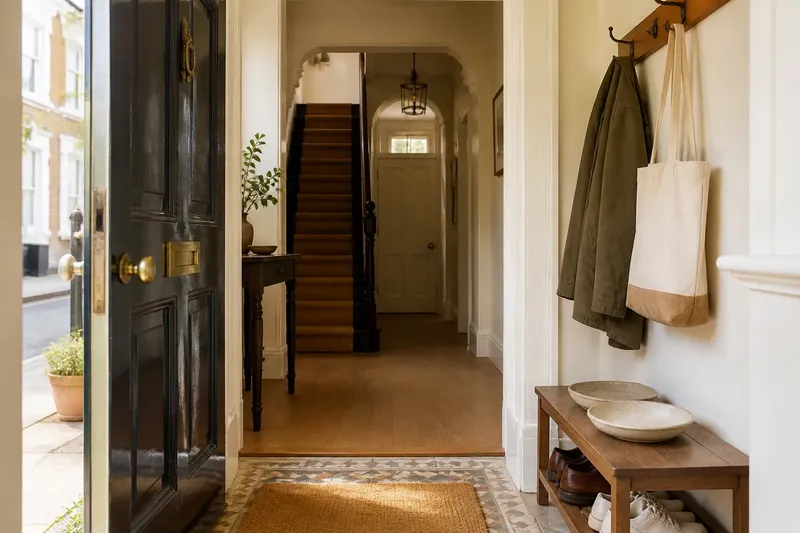
Why does a home entrance feel like a room of its own, even when it is only a strip of floor beside the door? Home entrance history offers a grounded answer in the Roman atrium, the Georgian hall, and the Victorian vestibule: each arrangement managed arrival in a different way. These examples come from particular places and periods, not a single path followed by every home.
The Roman atrium organized arrival around a central room
In ancient Roman houses, the atrium was a central reception space reached from the street through an entrance passage called the fauces. It was not a hallway in the modern sense. The passage brought visitors into the house, while the atrium gave the household a place to receive them and to conduct domestic and social business.
That layout is a useful reminder that a threshold does not need a separate room to distinguish public arrival from private life. A direct route into a shared room can still feel deliberate when the approach and the receiving space are clear.
The Georgian hall made circulation part of the plan
In Georgian Britain, many substantial townhouses used a central hall to connect the front entrance with stairs and rooms on either side. The hall was a route through the house as well as a place to receive callers. Its proportions and decoration could signal the standing of the household, while doors helped separate circulation from rooms used for family life.
This arrangement should not be mistaken for a universal domestic change. Georgian houses varied by location, wealth, and plot, and a large central hall was not the norm for every household. Still, the plan makes one shift legible: in some homes, movement between rooms became a more explicit part of the entrance design.
The Victorian vestibule added a pause at the door
Some Victorian houses used a vestibule, a small enclosed space between the exterior door and the main hall. It could create a second barrier between outdoors and indoors and give an arriving visitor a moment to wait. The feature suited particular house plans and climates; it was not present in every Victorian home.
As halls and vestibules became places for coats, hats, and footwear, they also had to remain usable routes. That tension is still familiar: storage belongs close to the door, but a passage crowded with belongings stops working as a passage.
What does home entrance history clarify about an entryway?
Why did some homes have a vestibule?
A vestibule created an enclosed pause between the outside and the main interior. Depending on the house, it could help buffer drafts and offer a place for a visitor to wait before entering farther.
Why might a front entrance differ from a side door?
In some houses, the front entrance served visitors while another door handled routine household access or deliveries. The distinction reflected a particular plan and way of living, not a rule that applies to every home.
What should stay near an entrance?
Keep only the objects that support the household’s actual arrivals, such as a coat hook, key dish, or shoe tray. Place them so the door can open fully and the route into the home remains clear.
Small objects give a modern threshold its purpose
A mat, hook, or tray can assign a place to the small transitions of coming and going without turning an entryway into a formal foyer. Choose materials for their likely use: a coir mat can catch loose grit, while a washable runner may suit an interior where shoes are removed. A ceramic dish is useful for keys if it sits beyond the sweep of the door and away from passing bags.
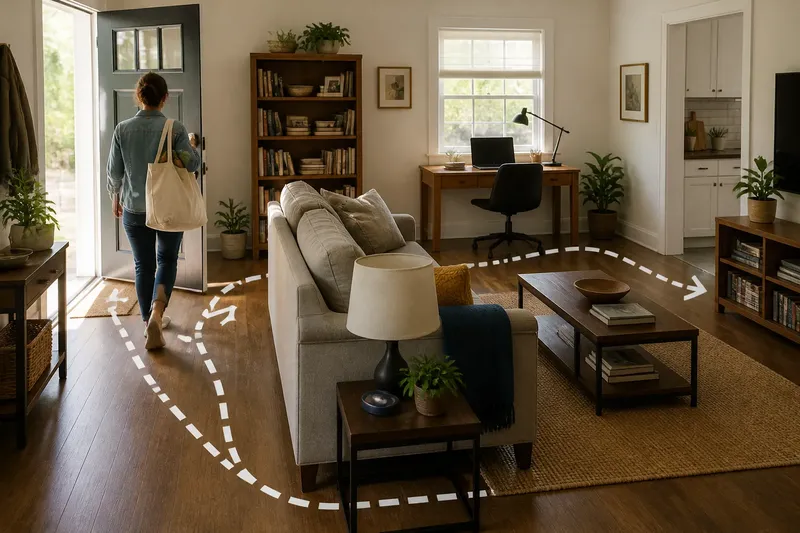
Say you enter a narrow apartment with a door that swings toward a small wall and wet coats that usually land on a dining chair. You check the door’s path, find a strip of wall outside that sweep, and put two hooks there; you place a washable mat on the floor without narrowing the route. Coats now have a designated place, and the mat can be removed for cleaning, though the limited wall space still leaves no convenient spot for bulky bags.
- If the door swings into the wall beside the entrance, check whether a hook or shelf would sit in its path; if it would, move the storage outside the swing or use a different wall.
- If shoes are regularly removed at the door, check whether a tray can sit without narrowing the route; if it fits, use the tray, and if it does not, keep footwear in a nearby closet.
- If grit collects on the floor, check whether the mat can be lifted and cleaned; if it can, place it at the main arrival point, and if it cannot, choose a removable mat instead.
- If keys are often left on another room’s surface, check whether a small dish can sit safely away from bags and door movement; if so, assign it that spot, and if not, use a wall hook or another stable location.
- If visitors naturally pause just inside the door, check whether that spot blocks the route to the next room; if it does, keep the area clear, and if it does not, place a simple cue such as a mat there.
- If coats collect on a chair, check whether a nearby wall can take hooks without crowding the passage; if it can, move the coats there, and if not, use a closet or freestanding storage outside the walking route.
A useful entrance makes its boundary clear
Home entrance history is less a story of one design replacing another than a record of different ways households have handled arrival. The atrium, hall, and vestibule each offered a distinct relationship between the street, the visitor, and rooms farther inside. A contemporary entryway can borrow that basic question without copying any period style: where should a person pause, and what should remain private?
Before adding furniture, watch where the door opens, where people stop, and where outdoor items accumulate. That simple observation often reveals whether the entrance needs a hook, a washable mat, or nothing more than an unobstructed path. The most useful threshold is the one that makes arrival understandable while leaving the rest of the home free to be lived in.